Managed Procurement Operations for a Global Energy & Utilities Group

Managed Procurement Operations for a Global Energy & Utilities Group

How a dedicated, SLA-governed outsourcing partner freed strategic procurement capacity and made every tracked process faster.

Client Large, fast-growing energy & utilities group with operations across multiple regions and a hybrid central + regional procurement model
Engagement Managed procurement operations: five transactional processes plus data analytics, run as an extension of the client’s supply chain team
Delivery model Remote delivery from EmpoweringCPO’s centre in India, working inside the client’s own ERP and e-sourcing platform
Team 17 specialists at launch, scaled to about 30 including data analytics
StatusLive and past its first year of operation, running against a formal SLA framework
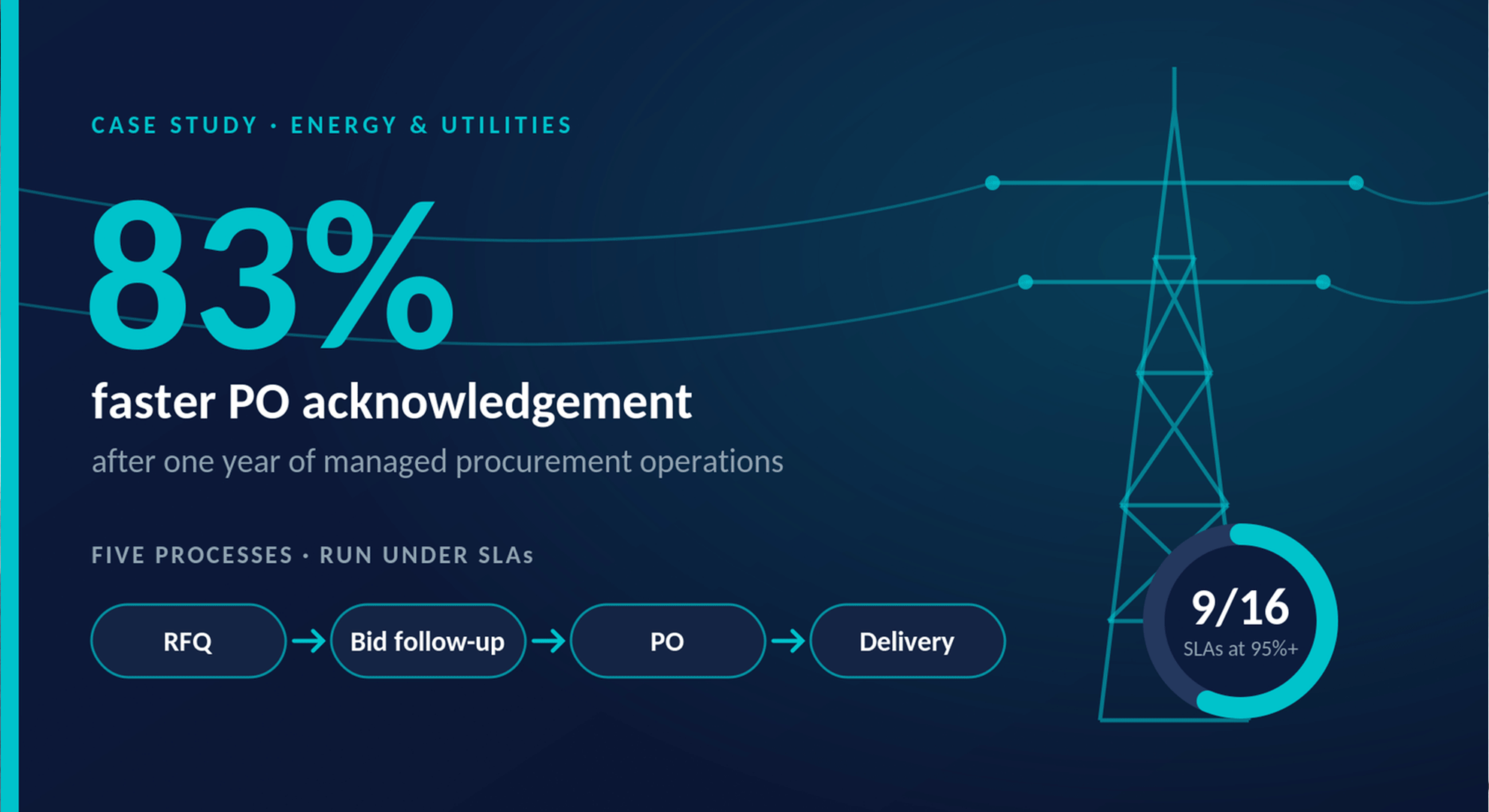
faster PO acknowledgement after one year (10.6 to 1.8 days)
0 %
faster supplier RFQ acknowledgement on contracts (5.6 to 1.25 days)
0 %
tracked sub-processes at 95%+ SLA adherence (latest monthly review)
0 of 16
POs and ~1,100 RFQs handled every month
~ 0

Executive Summary

A fast-growing energy and utilities group had outgrown the way its procurement function worked. Its strategic buyers were spending much of their time on high-volume transactional follow-up: chasing supplier acknowledgements, onboarding vendors, maintaining master data and keeping contracts moving.

The group engaged EmpoweringCPO as a specialist partner to take over defined transactional processes while the client kept strategic ownership. EmpoweringCPO mobilised a dedicated team in India and transitioned five processes in a phased, process-by-process programme.

In its first year the engagement built what the client did not have before: documented SOPs, a measurable SLA framework and reliable reporting. Every tracked parameter improved, with turnaround times falling by up to 83% and SLA adherence rising sharply. The team has since grown from 17 to about 30 specialists, and the client’s own leadership describes the effect as a tangible lift in efficiency and responsiveness.

1. The Challenge

The client’s procurement and supply chain function was a hybrid of central and regional teams, under pressure to scale in step with a rapid expansion of its plant and project portfolio. A recent maturity assessment had pointed to a new target operating model that used an outsourcing provider to streamline operations.

The day-to-day picture behind that decision:

  • Volume. A large transactional base: about 1,400 purchase orders and 1,100 RFQs a month today, 3,700+ registered suppliers and some 150,000 material and service codes.
  • Capacity. Buyers and contract managers were absorbed by follow-up work, leaving less time for sourcing strategy and supplier relationships.
  • Visibility. Policies existed, but SLAs were loosely tracked and there was no standard reporting to show how processes were really performing.
  • Consistency. Practices differed between regions, and some steps were new to parts of the organisation and its suppliers.

The client defined exactly which activities it wanted outsourced, set performance parameters up front, and expected specialised, focused process delivery that would cut workload for its employees and improve cost efficiency.

2. The Scope

Five processes were outsourced as managed services, with data analytics added as the engagement matured. Every task is executed inside the client’s own ERP and e-sourcing platform, and approvals remain with the client’s team.
Process What EmpoweringCPO executes
Supplier Management Supplier solicitation and pre-qualification; registration and onboarding on the e-sourcing platform; document and data checks; approval follow-up; ERP vendor-master integration and ongoing maintenance.
Procurement & Sourcing RFQ acknowledgement follow-up; technical clarifications between suppliers and end users; bid receipt follow-up and evaluation coordination; PO acknowledgement; pro-forma invoices and advance payment requests; delivery follow-up; secure recording of every interaction in the ERP.
Contract Management Contract-related RFQ/RFP coordination; supplier signature follow-up; contract release follow-up; user notification; kick-off scheduling; renewal and expiry tracking; change-order follow-up.
Inventory Management Creation and update of material and service master records; classification and validation; identification and merging of duplicate items; proactive master-data clean-up.
E-sourcing Platform Support Functional and technical support to suppliers, buyers and end users; supplier training guides; platform adoption.
Data Analytics (added in year one) SLA and KPI dashboards, performance reporting, exception analysis and reporting automation.

3. Our Approach

Mobilisation and transition

The programme combined a traditional, milestone-driven approach for mobilisation and knowledge transfer with agile review cycles once processes were live. Transitioning one process at a time kept risk low and let each team learn in a controlled way.

Phase Timing What happened
Mobilisation Months 0 to 3 Letter of intent and work order; two to three months to recruit, set up secure infrastructure and connectivity, and prepare plans, sub-plans and documentation.
Knowledge transfer From about month 4 Client experts trained the team one process at a time (about 14 weeks across all five), followed by at least six weeks of shadow working.
Hands-on & improvement After transfer Each process went live shortly after its knowledge transfer. Agile review cycles ran for roughly eight months, refining workflow, reports and targets.
Stabilisation Through year one SOPs, SLA framework, reporting and quality audit routines in place for every process; stakeholder and supplier behaviours aligned.
After one year Year two onward Steady-state performance against SLAs, proactive ownership by the team, analytics and automation extending the service.

Stabilisation: SOPs, SLAs and reporting

Once the early gaps were closed, every process was documented in its own SOP covering scope, responsibilities, mechanism, reports, SLAs and resources. The SOPs serve two purposes: they make onboarding future team members fast, and they act as the single source of truth if a question ever arises.

SLAs are defined at sub-process level, tracked monthly and reported to the client, so performance is measurable rather than aspirational. Sixteen SLAs, grouped here into seven service areas, are tracked every month:

Service area What is covered SLAs Target turnaround
Supplier registration and onboarding Account creation, document review, due diligence and registration 2 1 to 5 business days
RFQ and RFP acknowledgement and bid follow-up Supplier acknowledgement of requests and securing bids before closing, for both procurement and contracts 4 About 3 days to acknowledge; bids secured before closing
Technical evaluation coordination Coordinating evaluation with end users and flagging delays 1 5 to 14 days, depending on scope
Contract signing, release and notification Supplier signature follow-up, approver follow-up, user notification and renewal paperwork 4 1 to 8 business days
PO acknowledgement and advance payments Supplier PO acknowledgement, advance payment requests and follow-up with finance 3 1 to 7 business days
Delivery follow-up Proactive follow-up ahead of due dates; buyer kept informed 1 On or before the PO delivery date
Master data creation and updates Creating and updating material and service records 1 2 to 3 days

Operating model and governance

  • Leadership. A project manager owns client value, the relationship and governance. A deputy delivery manager owns SLA performance, escalations and team stability.
  • Delivery. Dedicated teams for each process, plus a data analytics team producing SLA and KPI dashboards.
  • Assurance. An independent quality auditor checks SOP adherence and root causes, and an HR coordinator supports training, engagement and retention.
  • Cadence. A monthly performance review with the client covers volumes, SLA results, root causes and improvement priorities.

Exception management

Not every delay is within the provider’s control, and a credible SLA model has to say so. The team uses standard exception codes for suppliers that stay unresponsive after documented follow-ups, ticket evidence for system issues, ageing dashboards and escalation routes for approver delays, and checklists with pre-validation for incomplete documentation. That makes performance transparent and keeps attention on the causes that can actually be fixed.

4. Challenges and How We Solved Them

A transition of this size surfaces gaps. The team treated each one as an input to the improvement cycle.

Challenge How it was solved
Role clarity across regional stakeholders Regional alignment sessions coached stakeholders on scope, intent and ways of working as one team.
Processes new to some regions Suppliers and internal teams were coached on why each process matters, what is needed from them and how to do it, with EmpoweringCPO driving adoption.
No direct access to source data Co-designed system-generated source reports with the client’s IT team, consolidating activity triggers and status into a single tracker per process.
No standard SLA reporting Built progress, SLA-conformance and ad-hoc data reports for every process, later consolidated into dashboards.
Targets not calibrated to real effort Measured actual activity times and jointly recalibrated SLA targets with the client against the data.
Volumes above plan in some processes Added dedicated capacity so service levels were protected as volumes grew.
Supplier-side delays and platform unfamiliarity Standard exception codes, documented follow-up trails, ageing dashboards, escalation routes and supplier training guides.

5. Results

The baseline reflects performance in the period before the processes were handed over. The comparison below shows performance after one year of operation, using the average of the two most recent months. Not all parameters were available in the client’s historical data, so the table shows those that could be measured on both sides. Other areas, including supplier response times and delivery follow-up, improved more modestly and remain focus areas for the next phase.

Process Activity Measure Baseline After one year Change
Contract Management RFQ/RFP acknowledgement SLA ~55% ~100% +45 pts
Avg. TAT ~5.6 days ~1.3 days -78%
Contract release SLA ~40% ~95% +55 pts
Avg. TAT ~6.7 days ~2.7 days -60%
Procurement & Sourcing RFQ/RFP acknowledgement SLA ~60% ~75% +15 pts
Avg. TAT ~3.8 days ~1.2 days -68%
Supplier RFQ response rate Response ~45% ~80% +35 pts
PO acknowledgement SLA ~35% ~95% +60 pts
Avg. TAT ~10.6 days ~1.8 days -83%
Advance payment requests SLA ~45% ~85% +40 pts
Avg. TAT ~28.7 days ~16.6 days -42%
Managed Procurement Operations for a Global Energy & Utilities Group

Where the service stands today

The latest monthly review shows 9 of 16 tracked sub-processes at 95% or above and 14 of 16 at 86% or above, including 100% on supplier registration for RFQs, supplier RFQ and RFP acknowledgement on contracts, receipt of responses and user notification on contract release. The team now processes about 1,100 RFQs and 1,400 POs every month alongside regular supplier registration, material-code creation and contract work.

Behaviour has changed too. The contract management team proactively closes requests with minimal buyer intervention, and the e-sourcing support team shares training guides with newly registered suppliers before they ask. That shift, from reacting to owning the process, is what moves a service from adequate to dependable.

6. In the Client's Words

“The past year has brought significant progress in process improvements, boosting efficiency and responsiveness across our supply chain operations. The dedication of the teams involved has been instrumental in driving these results and has laid a robust foundation for our continued success. I look forward to seeing what we can achieve together in the coming year.”

Senior Leadership, Supply Chain Management, Global Energy & Utilities Group

7. Why It Worked

  • A capability, not headcount. The client kept strategic ownership and handed over defined activities. EmpoweringCPO ran them as an operations capability, with people, process, governance and analytics, rather than supplying manpower.
  • Measure first. Baselines, source reports and SLA dashboards were built early, so every improvement could be proven and every target tested against real data.
  • Phase the change. Transitioning one process at a time with structured knowledge transfer and shadow working protected service levels during the change.
  • Be transparent. Standard exception codes and escalation routes separated what the partner controls from what it does not, which built trust in the numbers.
  • Own adoption. Working with suppliers and internal stakeholders to adopt new practices turned the process from a rulebook into a habit.

8. What's Next

The partnership is now focused on lifting supplier acknowledgement and response rates, automating repetitive follow-ups and deepening analytics. The client has also set out a roadmap that can extend scope in volume, regions and process coverage as the business grows.

Is your procurement team stretched across transactions?

Start with one process. EmpoweringCPO takes on the execution and follow-up workload inside your existing systems, while approvals and strategy stay with your team.

Share this Post
Managed Procurement Operations for a Global Energy & Utilities Group

EmpoweringCPO is a team of experienced sourcing and procurement professionals with hands on experience of having worked with many fortune 500 companies. The company was founded in 2011 and since then has executed multiple strategic sourcing projects and have achieved average savings of 10-12% so far. In addition to Strategic Sourcing their other offerings are Spend Analysis, Procurement Intelligence, Procurement Analytics, Best Cost Country Sourcing, Procurement Outsourcing, Built Operate Transfer, Supplier Diversity, Sustainable Procurement, Tail Spend Management, Item Master Optimization, Collective Buying, Compliance Tracking and Managed Procurement Services.

Get A Call Back

Compliance Management Tool

Compliance management is very critical as otherwise the procurement organization may run into a scenario where there is a huge gap between realized savings and reported savings. Many procurement functions estimate large savings numbers when contracts are signed. They also invest significant time and effort in negotiating contracts for necessary goods and services, only to have a third or more of their purchasing dollars flow outside those deals. Some of the obvious fall-outs of non-compliance and maverick purchases are:

  • Very high prices
  • Risk of losing out on volume discounts and rebates

As compared to the current contract that was finalized after the sourcing process, the tool helps in tracking:

  • Vendor Compliance
  • Price Compliance

The objective of this tool is to ensure that the orders are placed only with the vendors that were shortlisted after the sourcing process and at the same price that was agreed upon and negotiated during and after the strategic sourcing process.

Request Tool Demo